


 Cart
Cart
 sales@molnova.com


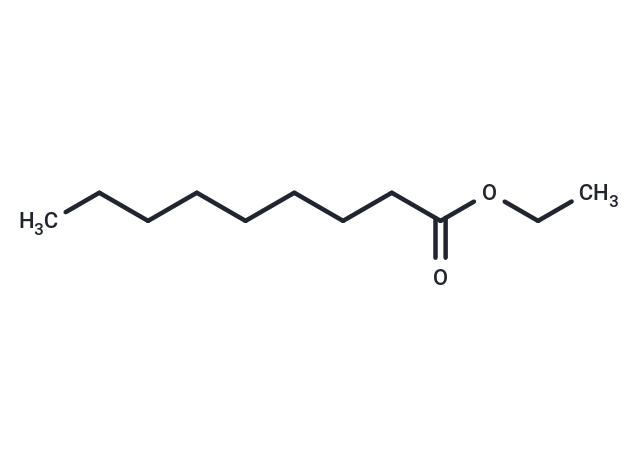
Ethyl nonanoate
CAS No. 123-29-5
Ethyl nonanoate( —— )
Catalog No. M33599 CAS No. 123-29-5
Ethyl nonanoate (Ethyl pelargonate) is an abundant ester in spirits, and its presence is usually associated with the aroma of alcoholic beverages.
Purity : >98% (HPLC)
 COA
Datasheet
HNMR
HPLC
MSDS
Handing Instructions
COA
Datasheet
HNMR
HPLC
MSDS
Handing Instructions
| Size | Price / USD | Stock | Quantity |
| 1G | 26 | In Stock |


|
Biological Information
-
Product NameEthyl nonanoate
-
NoteResearch use only, not for human use.
-
Brief DescriptionEthyl nonanoate (Ethyl pelargonate) is an abundant ester in spirits, and its presence is usually associated with the aroma of alcoholic beverages.
-
DescriptionEthyl nonanoate is a rich ester in spirits and its presence is commonly related to the pleasant fruity bouquet of alcoholic beverages. Ethyl nonanoate is an endogenous metabolite.
-
In Vitro——
-
In Vivo——
-
Synonyms——
-
PathwayProteasome/Ubiquitin
-
TargetEndogenous Metabolite
-
RecptorEndogenous Metabolite
-
Research Area——
-
Indication——
Chemical Information
-
CAS Number123-29-5
-
Formula Weight186.29
-
Molecular FormulaC11H22O2
-
Purity>98% (HPLC)
-
SolubilityIn Vitro:?DMSO : 100 mg/mL (536.80 mM; Ultrasonic )
-
SMILESCCCCCCCCC(=O)OCC
-
Chemical Name——
Shipping & Storage Information
-
Storage(-20℃)
-
ShippingWith Ice Pack
-
Stability≥ 2 years
Reference
1. Nascimento ES, et al. Quantitative ester analysis in cachaca and distilled spirits by gas chromatography-mass spectrometry (GC-MS). J Agric Food Chem. 2008 Jul 23;56(14):5488-93.?
molnova catalog



related products
-
Cardiolipin (Heart, ...
Cardiolipin (Heart, Bovine) sodium is a phospholipid found in mitochondria and is involved in mitochondrial structure and function.Cardiolipin (Heart, Bovine) sodium is used in the study of neurological, cardiovascular, and metabolic diseases.
-
D(+)-Xylose
Xylose or wood sugar is an aldopentose - a monosaccharide containing five carbon atoms and an aldehyde functional group. It has chemical formula C5H10O5 and is 40% as sweet as sucrose.
-
Heparan Sulfate
Heparan Sulfate is a complex and linear polysaccharide, exists as part of glycoproteins named heparan sulfate proteoglycans, which are expressed abundantly on the cell surface and in the extracellular matrix.
